
Enterprise interoperability
System integration for Niagara 4, from legacy equipment to cloud data
We specialise in “impossible” integrations. From legacy serial protocols to high-throughput Apache Kafka streams, we engineer the drivers that make your infrastructure talk.
BACnetModbusM-BusOPC UAMQTTKafkaRESTSerial
Niagara 4one object model
Protocol portfolio
Whatever it speaks, we connect it
Whether it’s a 30-year-old chiller or a cloud-native microservice.
Industrial / PLC
Enterprise & big data
Architecture
Matching the technology to the job
The right integration depends on how fast the data must move and who needs it.
| Operational goal | Technology | Data velocity | Business value |
|---|---|---|---|
| Real-time local control | Native Java drivers / BACnet | Milliseconds | Safety loops and immediate equipment response, with no cloud latency. |
| Enterprise streaming | Apache Kafka / gRPC | High throughput | Scales data from thousands of sites into a central lake for AI and portfolio auditing. |
| Legacy retrofitting | Custom serial bridge | Stable / asynchronous | Extends the life of expensive machinery by making proprietary data readable in Niagara. |
Scenarios
Typical integration scenarios
Patterns we deliver again and again — adapted to your site.
Legacy rescue
The 25-year-old chiller
The problem
A plant-critical chiller speaks a proprietary serial protocol the manufacturer no longer documents. Replacement would cost seven figures.
Our approach
Frame-level protocol analysis, then a custom serial driver that exposes setpoints and alarms as standard Niagara points. How this works.
Scale-out
Portfolio data pipeline
The problem
Forty sites, each with its own station, and a head office that wants one live dataset for AI-driven optimisation.
Our approach
MQTT Sparkplug B or Kafka publishers embedded in each station, streaming normalised, tagged telemetry into a central data lake.
Cost recovery
Tenant sub-metering
The problem
Hundreds of M-Bus and Modbus meters across a mixed-use development, with billing handled in spreadsheets.
Our approach
Bulk meter integration with automated read validation, feeding a billing module that exports straight to the finance system.
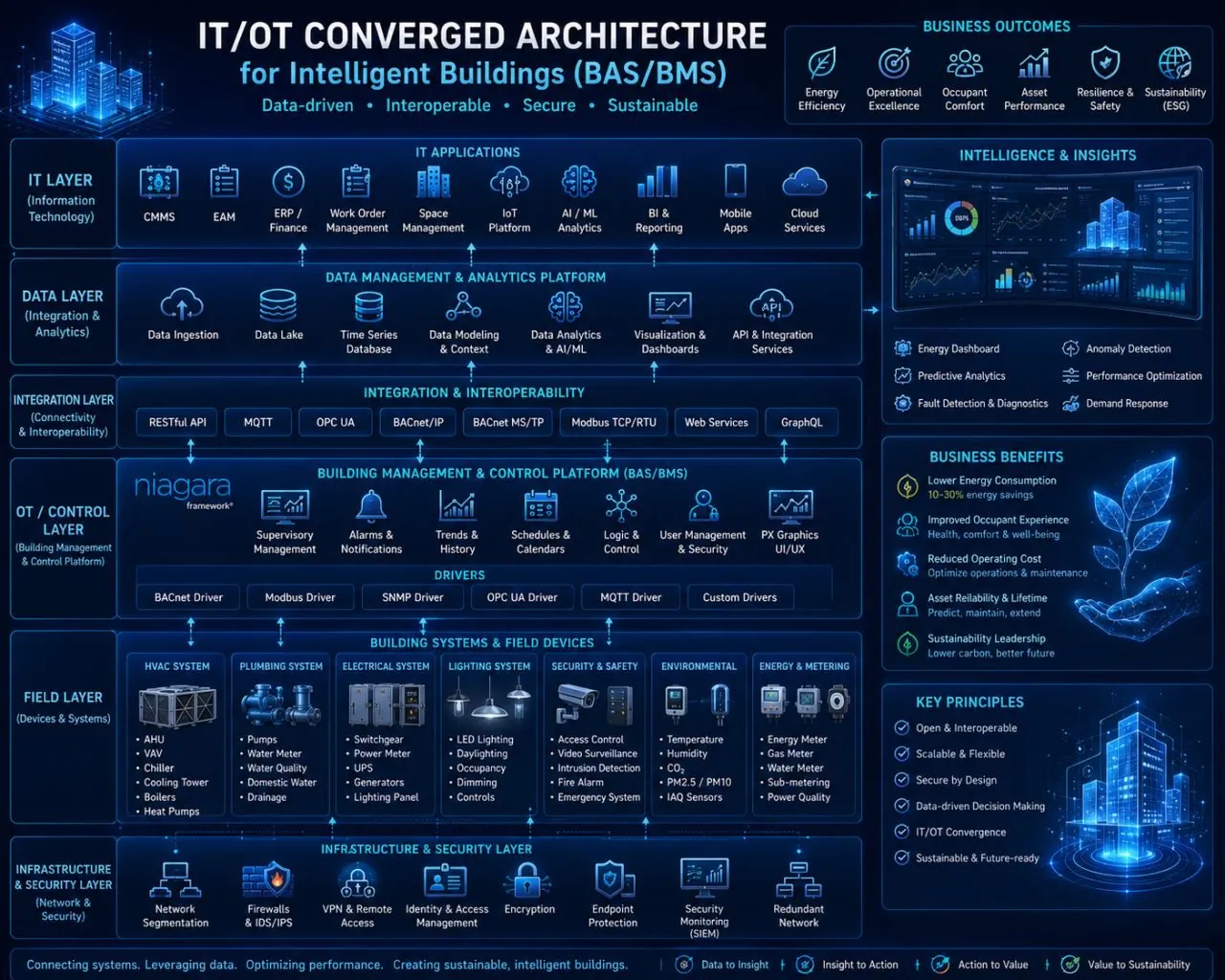
IT/OT converged architecture
Where integration sits in a modern building: between field devices and controllers below, and enterprise applications and analytics above.
 Full size
Process
The driver engineering lifecycle
How a proprietary cable becomes a native Niagara palette.
Packet analysis
We capture raw network traffic and reverse-engineer proprietary data structures — passively, without disturbing the equipment.
Java development
We write native Niagara 4 modules that treat foreign data as native Niagara points.
Stress testing
Rigorous load testing to rule out memory leaks or station crashes under heavy traffic.
Unified palette
The finished driver appears as a drag-and-drop tool for your technicians.
OT / IT convergence
Integration without exposure
Connecting field equipment to enterprise networks widens the attack surface — unless it is engineered deliberately. Security is a design input on every integration we deliver, not an afterthought.
- Network segmentationField, station and enterprise traffic separated by design, with one-way data paths where control is not required.
- Encrypted transportTLS for IP protocols, certificate management included — no plaintext telemetry crossing network boundaries.
- Signed modules onlyEvery deployed driver is code-signed, so your station refuses tampered or unknown binaries.
- Least-privilege accessRole-based station users and scoped API credentials — the cloud never gets write access it does not need.
Frequently asked questions
Can you integrate equipment the vendor calls “unsupported”?
That is our specialty. If the device communicates at all — serial, IP or otherwise — we can usually capture, decode and normalise its data into native Niagara points.
Will integration work disrupt building operations?
No. Protocol capture is passive, development happens against a replica station, and cut-over is staged — typically during planned maintenance windows.
Do we have to replace our existing BMS?
No. The point of integration is to extend what you have. Existing controllers keep running; we add the translation layer that makes their data usable.
How long does a custom driver take?
A well-documented protocol typically takes weeks; reverse-engineering an undocumented one takes longer. The discovery phase produces a fixed estimate before development begins.
Related
Service
Software Development
Custom BComponents, drivers and web widgets in native Java — signed, soak-tested and yours to own.
Service
Energy Analytics
IPMVP-aligned M&V, fault detection and stakeholder reporting from the data your station already collects.
System integration
Integrating legacy equipment
The manufacturer is gone, the manual is missing, and the equipment still runs the plant. A step-by-step look at how undocumented devices become native Niagara points — without putting operations at risk.
Have equipment nobody else will touch?
Describe your station, protocol or data challenge — an engineer replies within 24 hours.